I found out from a photograph. My sister got married in the spring, and there is a picture of the four of us on the lawn with me on the end, squinting slightly, holding a drink. I am smiling. I look exhausted.
Not older, exactly. That's the part I couldn't explain to anyone. I looked tired. Under the eyes, along the jaw, in the way my makeup had settled into places it never used to settle into by four in the afternoon.
I was only thirty-eight. I had slept eight hours the night before.
For about two years after that I did what I think most women do, which is to spend my way out of it. If the problem was my face, then the answer was on my face, and there were a great many people willing to sell me the answer.
What I was doing vs. what was actually happening
Everything in the left column is real, and none of it was wrong. It was all just aimed at the wrong layer.
- A vitamin C serum, $118 a bottle, every six weeks
- Prescription retinol, nightly, for four years
- Two rounds of injectables
- A collagen powder in my coffee every morning
- Facials I couldn't really justify
- Cellular energy production quietly slowing
- The repair signal being sent less often
- Antioxidant defenses thinning out
- Everyday DNA upkeep getting deferred
- Low-grade inflammation running in the background
The shelf was getting more expensive and I wasn't getting less tired
By the second year I had a shelf that looked like a small pharmacy and a face that still looked like it hadn't slept. My husband stopped commenting on the packages. I started taking photographs in better light and standing at a slight angle, which is its own kind of admission.
What kept nagging at me was that none of it was wrong. The retinol was doing something. The serum was doing something. My skin was smoother than it had been. It just wasn't the thing I was actually upset about. It was the tiredness. It was looking depleted in a photograph after eight hours of sleep.
Then someone explained to me why none of it could have worked
It came up in the least dramatic way possible. A friend who works in pharmaceutical research, at a kitchen table, not trying to sell me anything. I was complaining about the collagen powder and the serum, and she asked me if I knew how big a collagen molecule was.
I did not.
There's a rule in dermatology that's been around since 2000: molecules bigger than about 500 Daltons don't meaningfully cross intact skin. It's why skincare formulators design around it.
A collagen molecule is somewhere around 300,000 Daltons.
So whatever my collagen cream was doing for me, however moisturizing it was, it was not putting collagen back into my skin. It physically could not. My skin was doing its job, which is to keep things out.1
I want to be careful here, because this is the point where these articles usually tell you to throw everything away. Don't. Good skincare protects your barrier, holds water, defends against sun damage and genuinely smooths texture. Mine still does all of that and I still use it.
But it works on the surface. And the thing I was upset about (the depleted look, the tiredness that sleep wasn't fixing) wasn't being generated on the surface. It was being generated several layers down, inside cells, by systems I'd never once thought about.
Your cells run on something that gets scarcer every decade
Here's the part she explained next, and it's the part I wish someone had told me at thirty.
Every cell in your body, skin cells included, depends on a coenzyme called NAD⁺ to do its daily work. It isn't a trend and it isn't a vitamin. It's closer to electricity: nothing that repairs, rebuilds or protects can run without it.
And it doesn't hold steady across a lifetime. When researchers measured NAD⁺ directly in human tissue, they found levels dropping substantially between young adulthood and middle age.2 You don't feel that on any particular Tuesday. What you feel is the slow shift in the ratio between how fast you damage and how fast you repair.
Which, it turns out, is exactly what I had been looking at in that wedding photograph.
Aging isn't one problem. It's four running at once
This is where I'd gone wrong for nine years, and where most products still go wrong. They pick one lever and pull it hard. One antioxidant. One peptide. One molecule.
But cellular aging isn't a single lever. It's four connected systems that slip together, each one making the others harder. Supporting one while the other three keep sliding is renovating a kitchen in a house with a leaking roof.
The alternative has a name: multi-pathway activation, which supports all four at once, because in the body they never operate separately.
Cellular energy
Mitochondria turn fuel into usable energy, and can't do it without NAD⁺. Repair is expensive and a tired cell defers maintenance the way a tired person does.
Sirtuin signaling
Sirtuins are the proteins that tell cells to switch into maintenance mode. They're strictly NAD⁺-dependent and when it's scarce, the instruction never gets sent.
Antioxidant defense
The daily wear from sun, pollution, stress and ordinary metabolism. Defending against it is a supply problem, and supply thins with age.
DNA upkeep
The enzymes that patch everyday DNA damage draw on the same NAD⁺ pool. When it's tight they compete with everything else, meaning something gets deferred.
Inflammation balance
Researchers named it “inflammaging”, the low-grade inflammatory tone that rises quietly with age.3 It matters because it works against renewal: an inflamed system spends on defense instead of repair. This was the piece I'd never accounted for, and in hindsight it was probably my whole problem.
What I actually changed
Almost nothing, is the honest answer. I kept my skincare. I kept the retinol. I stopped the collagen powder eventually, though that was more about the coffee than a conviction.
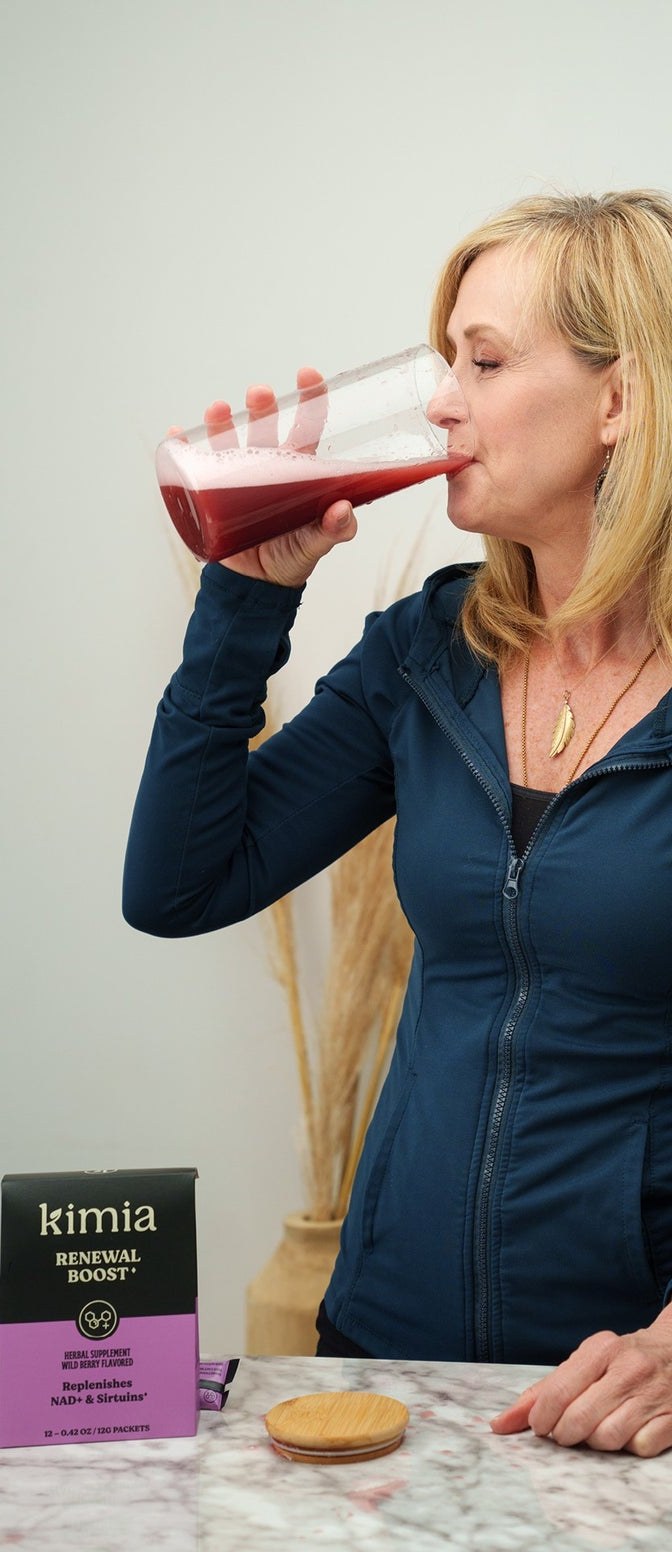
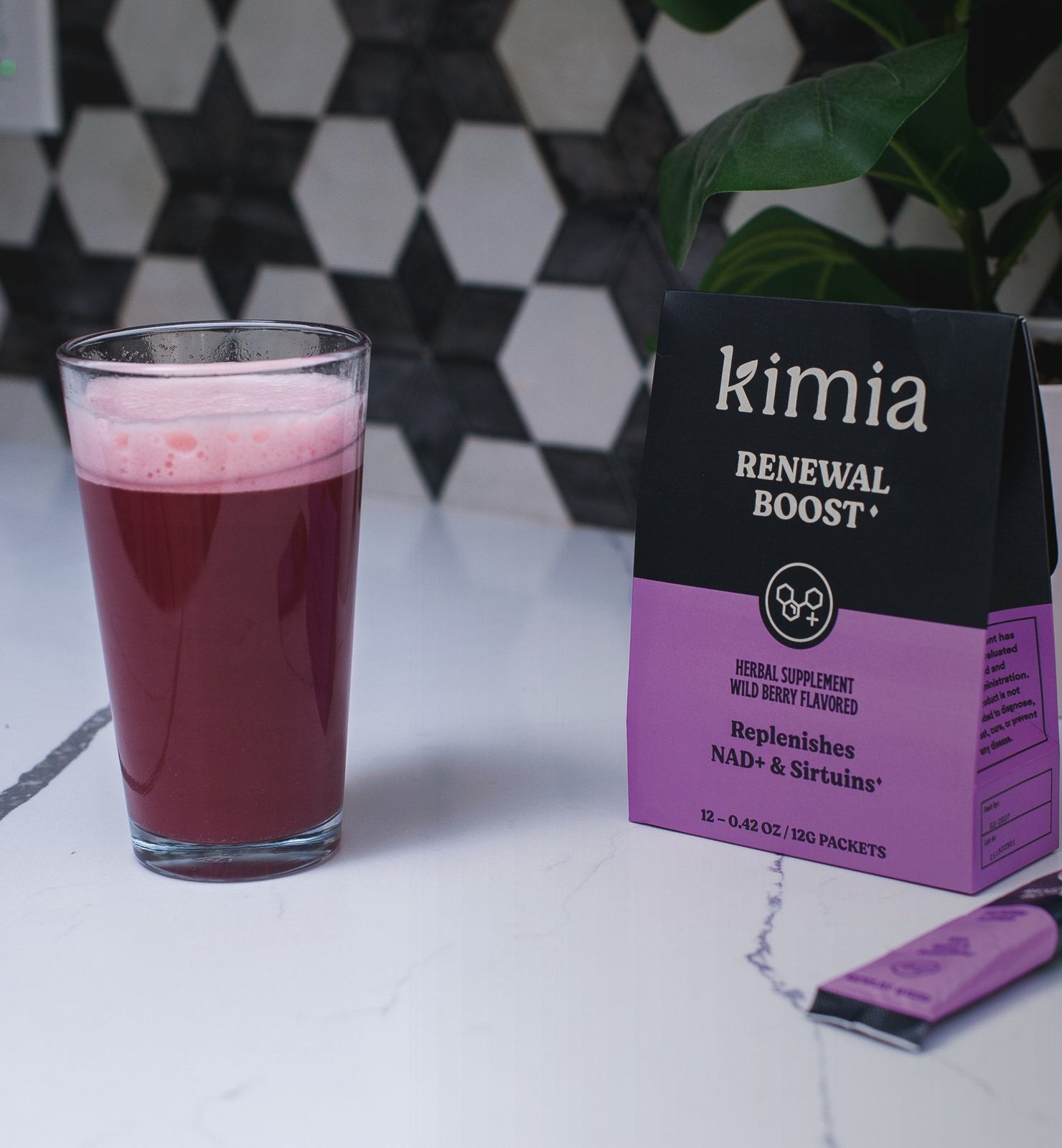
What I added was one stick pack of powder stirred into a glass of cold water in the morning. A plant-based renewal blend for the four pathways, paired with a second blend for the inflammation side. Wild berry. It takes about eleven seconds.
I'd tried capsules before. There's a bottle of something expensive in my cupboard, still two-thirds full, from 2023. The difference with a drink, for me, was that it became a thing I did rather than a thing I was supposed to remember.
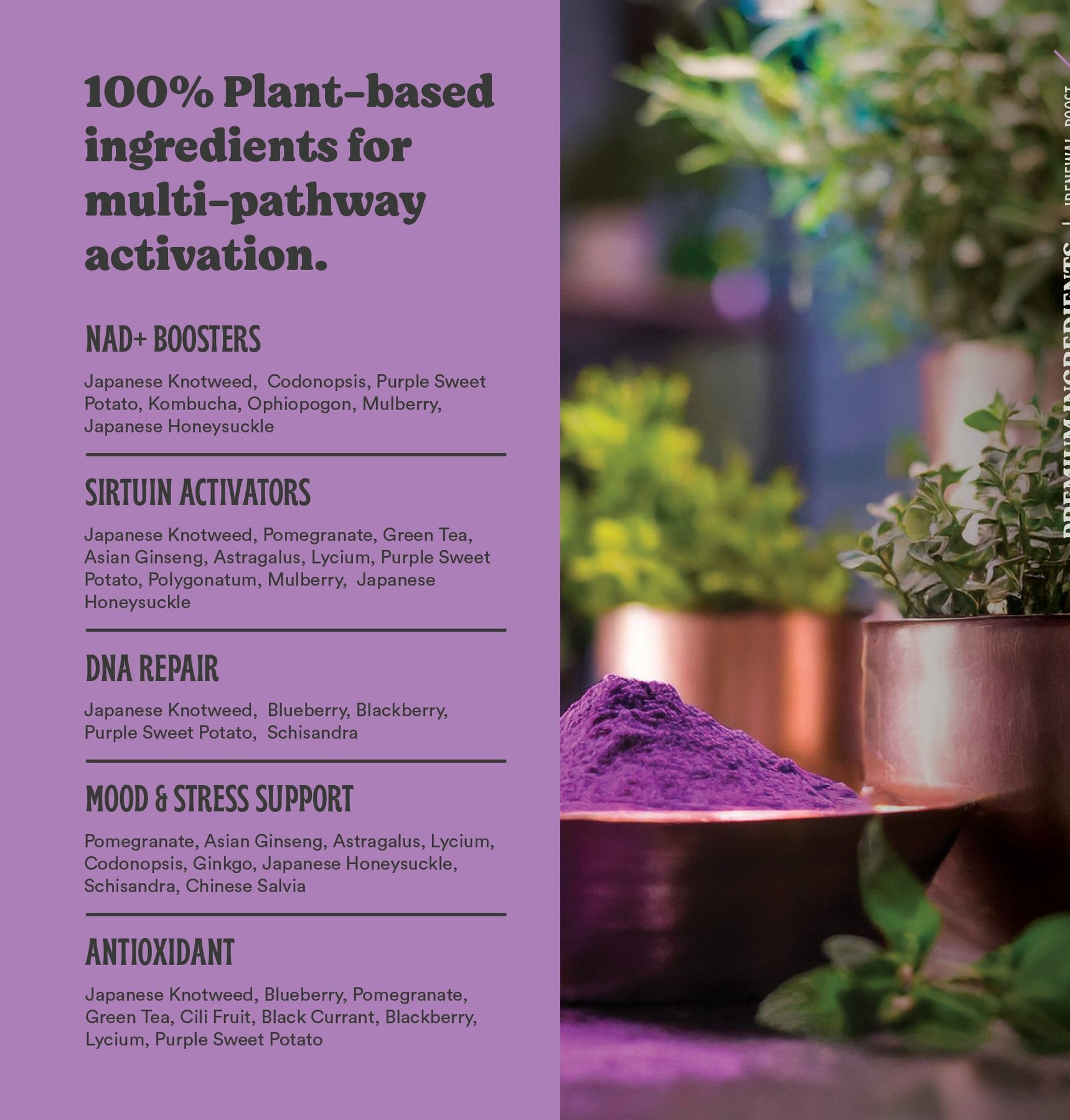
The other thing that persuaded me, for what it's worth, was reading the back of the box. I'd assumed anything in this category was a lab-made molecule, that's what the well-known brands sell. This was a list of plants.
“Renew at the cellular level while supporting a calm, balanced inflammation response.”
See what she takes → ★★★★★4.6 / 5 from verified buyersThe before, and the after
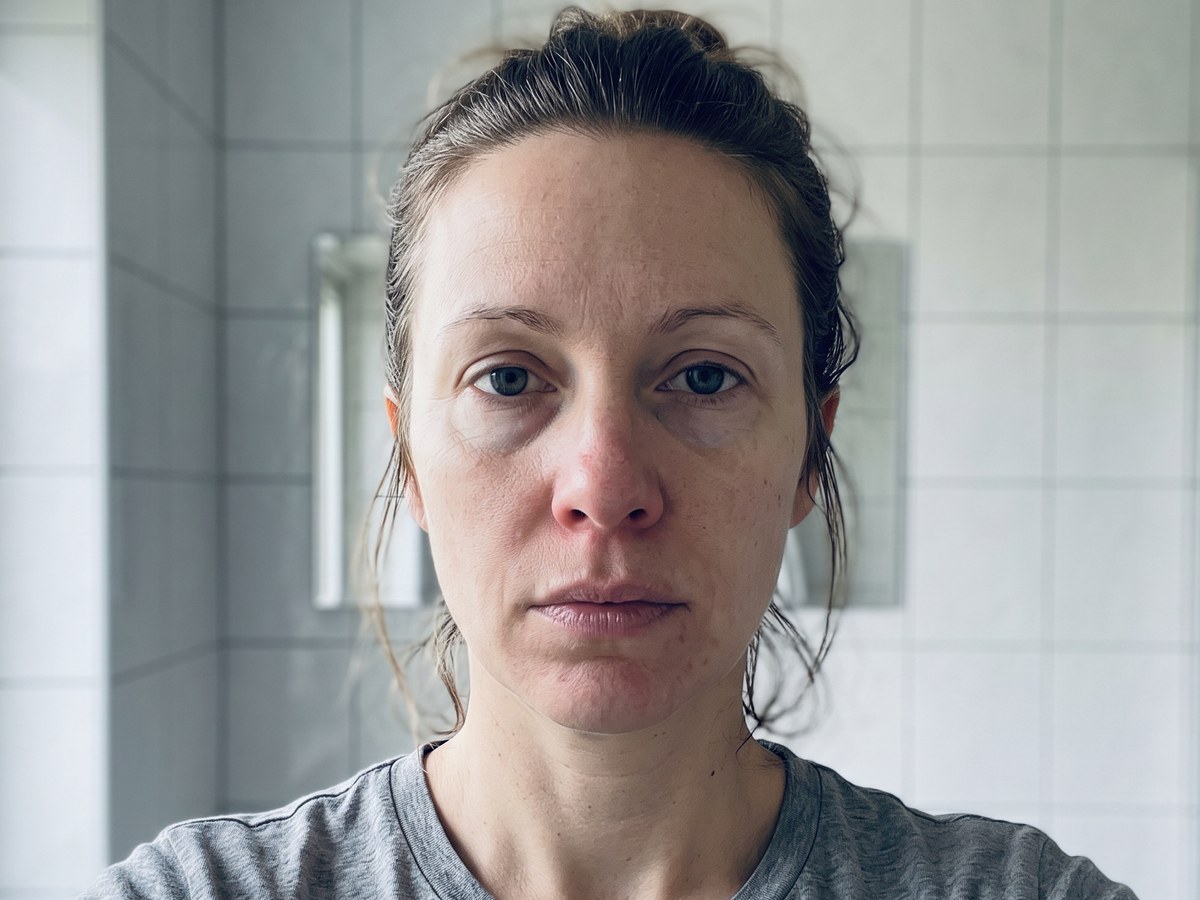
Same bathroom, same morning light, same grey t-shirt, no makeup in either frame. The only variable is ninety days.
- Looked tired in every photograph
- Makeup settling into lines by mid-afternoon
- A hard crash somewhere around three o'clock
- Skin took days to settle after a bad week
- Eight hours of sleep, and it didn't show
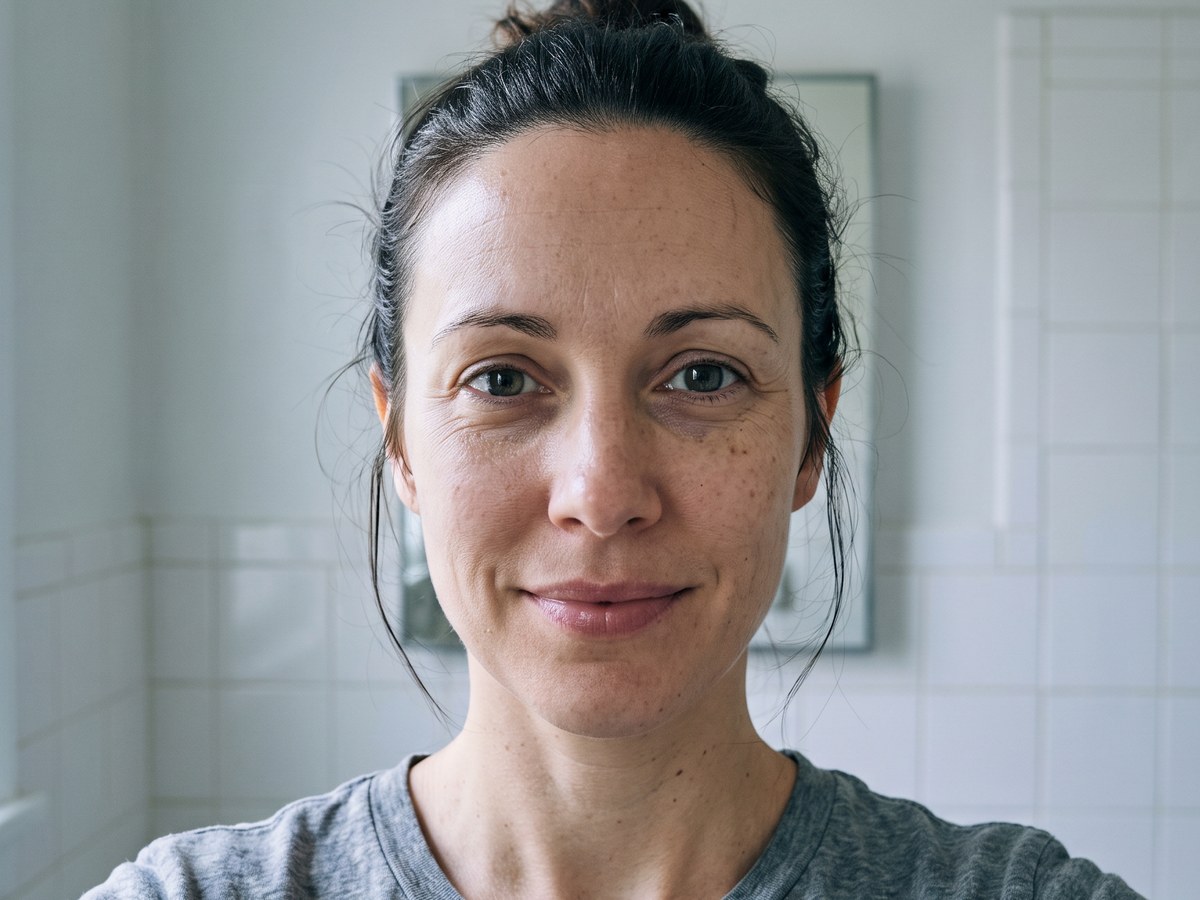
- Stopped angling away from cameras
- Makeup sitting where I put it, all day
- The afternoon stopped being something to survive
- Bad weeks stopped showing up on my face for days
- Rested, which is all I ever actually wanted
What the ninety days actually looked like
Anyone promising a visible change in a week is selling you the surface again. This works on the timeline cells work on, which is slower than a facial and considerably more durable. Here's the honest shape of it, in the order it happened for me.
The afternoon came back first
Nothing in the mirror. What changed was three o'clock, the flat, foggy hour I'd been treating as a personality trait. It stopped being the worst part of my day. That was the first thing that made me keep going.
Recovery got shorter
A hard week used to sit on my face for days afterward. Somewhere in here it stopped doing that. My skin got back to normal faster, and that's the inflammation side doing its part alongside the renewal blend.
The part I'd been after the whole time
Skin renewal runs on roughly a monthly cycle, so this layer needs several cycles before it shows. Around week nine my sister asked what I'd had done. I hadn't had anything done. That's the whole story, really.
Real customers, in their own videos. Individual results vary.
“Around week nine my sister asked what I'd had done. I hadn't had anything done.”
See the pairing · 30% off → ★★★★★36 stick packs · $62.99 · 30-day guaranteeWhat other women say about the same blend
The renewal blend carries a 4.6 out of 5 average from verified buyers. A few of them, in their own words.


Individual results vary. Reviews reflect individual experiences and are not a guarantee of any particular outcome.
What I take now, and what it costs
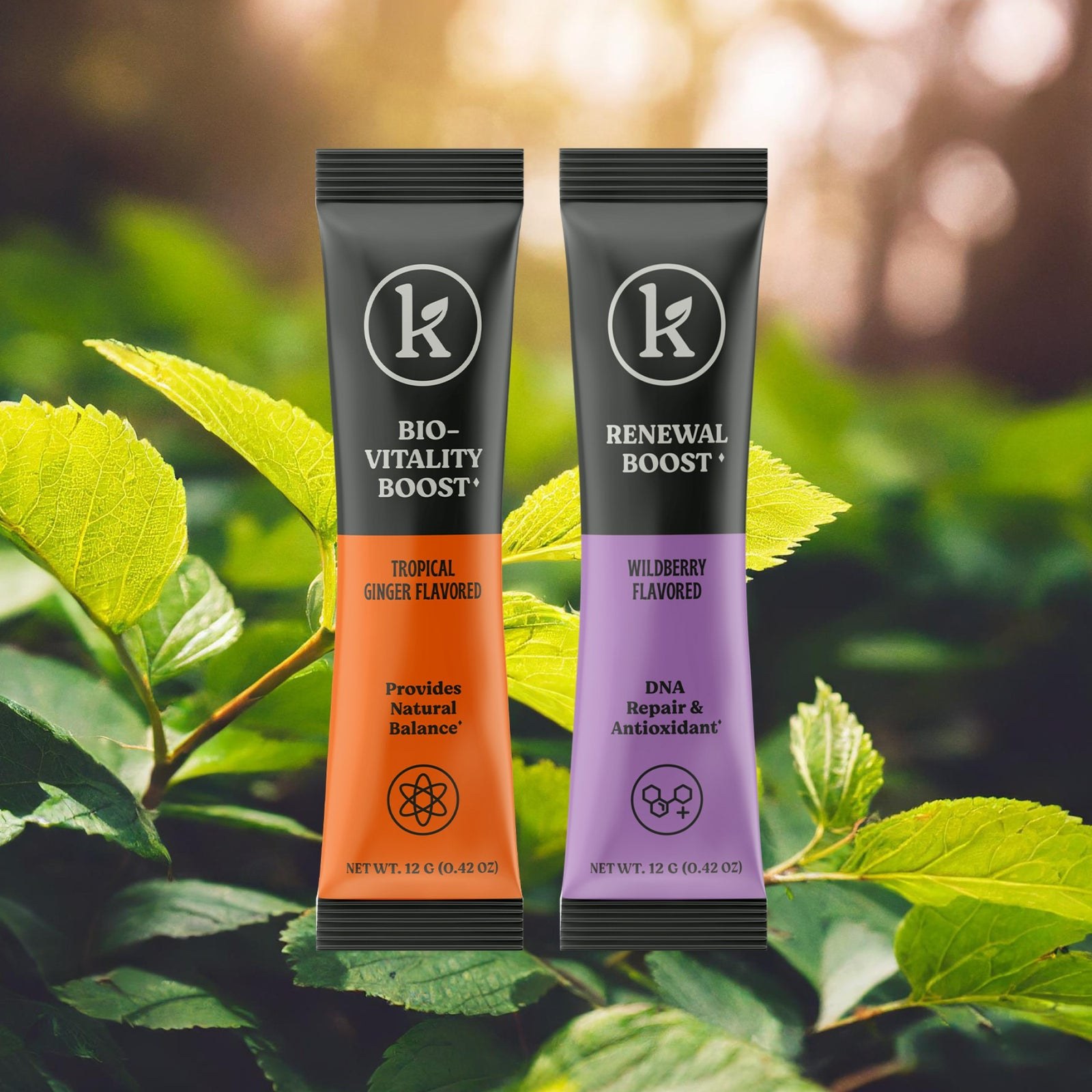
It's sold as Recover & Renew, two cartons of the renewal blend (the NAD⁺ and sirtuin side, pathways one through four) paired with one carton of the inflammation-balance blend. Thirty-six single-serve stick packs, which is a little over a month.
You buy it once. There's no subscription to remember to cancel, which after nine years of auto-shipping serums I had genuinely stopped expecting.
Recover & Renew: the inside-out pairing
Cellular renewal support and inflammation balance, in one daily glass. 36 stick packs, a full 36-day supply.

-
 2 × Renewal Boost: 24 sticks The NAD⁺ and sirtuin side. Supports cellular energy, DNA upkeep and antioxidant defense, pathways 1 through 4.
 -
 1 × Bio-Vitality Boost: 12 sticks Adaptogenic and herbal support for a normal, balanced inflammation response, the fifth pathway.
- Plant-based: botanical, not synthetic single-molecule
- Dissolves in water: no capsule to break down first
- One-time purchase: no subscription, nothing to cancel
You save $27.00
36 stick packs, about $1.75 a day.
Roughly the cost of the coffee it replaces.
Backed by a 30-day money-back guarantee. Free shipping on orders over $50, and this one qualifies.
Questions I get most often
Since I started talking about this, the same handful of questions come up every time.
Is 30 too early to be thinking about this?
It's arguably the right time and I wish I'd started earlier. The pathway decline that shows on your face in your forties begins well before it becomes visible, which is the entire reason it's easy to ignore. Supporting repair while the system is still working well is a different proposition from trying to catch up later.
Do I stop using my serums and retinol?
No, topicals do real work at the surface: barrier, hydration, texture, UV defense. This works at a layer they can't reach. The women who are happiest with it treat it as the layer underneath their routine, not a replacement for it.
How is this different from a collagen powder?
Collagen supplies a building material. This is aimed at the machinery that decides how much building gets done at all, such as cellular energy, the sirtuin repair signal, antioxidant defense and DNA upkeep. They're not competitors; they answer different questions. If you already take collagen, this sits underneath it.
Why not just take an NAD⁺ capsule?
You can, and plenty of women do. Two differences are worth weighing. First, most of the well-known NAD⁺ capsules are built on a synthetic single molecule aimed at one lever; this is a plant-based blend built to support several pathways at once. Second, a powder that dissolves in water doesn't have to be broken out of a capsule shell first, and for me that was the difference between a ritual I kept and a bottle I forgot.
If you get on with the daily glass and want to go further later, the same makers do a plant-based NAD⁺ and sirtuin capsule pair designed to layer on top of it. That's a decision for month three, though. Start with the sticks.
What does it taste like, and how do I take it?
One stick pack stirred into a glass of cold water, once a day. Most people take it in the morning. The blends are fruit-forward rather than grassy, more like a berry drink than a greens powder.
Is there a subscription?
No. This is a one-time purchase of 36 stick packs. Nothing auto-renews, and there's nothing to remember to cancel.
How long until I should judge whether it's working?
Give it the full box, and ideally two. Energy and recovery were the first things I noticed, and that matches what most reviews describe, within the first few weeks. Anything at the skin layer follows the skin's own renewal cycle, which means eight to twelve weeks is the fair window, not just seven days.
What if it doesn't do anything for me?
There's a 30-day money-back guarantee. If you're not happy with it, you can get your money back. That's the reason to try it now rather than research it for another six months.
Is it safe with my other supplements or medication?
These are botanical blends, and for most people they sit alongside a normal supplement routine without issue. That said, if you're pregnant or nursing, managing a medical condition, or taking prescription medication, check with your doctor before starting anything new. That advice is genuine, not a formality.
Start with one box
36 stick packs. Four renewal pathways and the one that undoes them. Thirty days to decide whether it earned its place on your counter.

- 2 × Renewal Boost (24 sticks): the four-pathway renewal side
- 1 × Bio-Vitality Boost (12 sticks): inflammation balance
- 30-day money-back guarantee: the risk sits with them, not you
- Free shipping on orders over $50
- No subscription: buy it once
Save 30%
About $1.75 a day for the layer none of the rest of it reaches.
Get Recover & Renew 30% off · free shippingShips from Kimia Wellness. Price and availability subject to change.
- Bos JD, Meinardi MMHM. “The 500 Dalton rule for the skin penetration of chemical compounds and drugs.” Experimental Dermatology, 2000.
- Massudi H, Grant R, Braidy N, et al. “Age-associated changes in oxidative stress and NAD⁺ metabolism in human tissue.” PLoS ONE, 2012.
- Franceschi C, Bonafè M, Valensin S, et al. “Inflamm-aging: an evolutionary perspective on immunosenescence.” Annals of the New York Academy of Sciences, 2000.
- Imai S, Guarente L. “NAD⁺ and sirtuins in aging and disease.” Trends in Cell Biology, 2014.
- Shuster S, Black MM, McVitie E. “The influence of age and sex on skin thickness, skin collagen and density.” British Journal of Dermatology, 1975.
Cited research describes general biology and is not a study of any product named on this page. No claim is made that any product replicates these findings.